
Since the 1950s, the Ringing Scheme of East Africa has played a central role in helping to uncover the hidden lives of birds. By placing small, uniquely numbered rings on birds, trained researchers can learn where birds travel, how long they live, and which places are most important for their survival.
Coordinated by the Ringing Subcommittee of the Bird Committee of the East African Natural History Society (Nature Kenya), the scheme connects East Africa to the rest of the world, showing how birds link countries and continents through their incredible journeys. The information collected supports bird conservation and helps protect the habitats birds depend on.
You can be part of the story.
If you ever find a bird with a ring—whether alive or dead—please let us know. Reporting the details on the ring helps scientists understand that bird’s journey and makes a real difference for conservation across East Africa.
Every ring has a story. Help us tell it.
Intermediate Egret has been split into 3 species, the Plumed, Medium and Yellow-billed.
The original species reference (60) has been retired and 3 new numbers assigned.
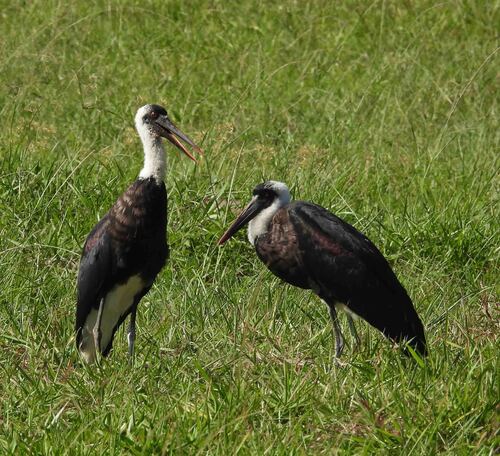
The Woolly-necked Stork (Ciconia episcopus) has been split into two species, the African Woolly-necked Stork (Ciconia episcopus, 14836) and the Asian Woolly-necked Stork (Ciconia episcopus, 14837). Across the BirdMap family of projects (incl. SAFRING and CWAC), the original Woolly-necked Stork species reference number (77) will be retired, and the projects will continue with the two new species reference numbers that have been allocated.
On the BirdLasser app, you will notice an [x] prefixed to the 'old' species: [x] Woolly-necked Stork, starting from 25-03-2025. You will now need to change this species in the trip cards to the applicable one, African or Asian Woolly-necked Stork. Also, make sure you log the correct species going forward (and submitting to SABAP2).
| Ring | Ringing date | Common name | Taxanomic name | Location code |
|---|---|---|---|---|
| XL0250 | 2022-03-09 | Sparrow, Kenya | Passer rufocinctus | 0140S3651E |
| T74752 | 2022-03-09 | Sparrow-Lark, Fischer's | Eremopterix leucopareia | 0140S3651E |
| T74740 | 2022-03-09 | Sparrow-Lark, Fischer's | Eremopterix leucopareia | 0140S3651E |
| XL0249 | 2022-03-08 | Sparrow, Kenya | Passer rufocinctus | 0140S3651E |
| XL0249 | 2022-03-08 | Sparrow, Kenya | Passer rufocinctus | 0140S3651E |
| T74765 | 2022-03-08 | Sparrow-Lark, Fischer's | Eremopterix leucopareia | 0140S3651E |
| K91866 | 2022-03-08 | Weaver, Speckle-fronted | Sporopipes frontalis | 0140S3651E |
| K91865 | 2022-03-08 | Weaver, Speckle-fronted | Sporopipes frontalis | 0140S3651E |
| K91864 | 2022-03-08 | Weaver, Speckle-fronted | Sporopipes frontalis | 0140S3651E |
| AB5937 | 2022-03-08 | Weaver, Speke's | Ploceus spekei | 0140S3651E |
| T74764 | 2021-11-26 | Sparrow-Lark, Fischer's | Eremopterix leucopareia | 0140S3651E |
| T74763 | 2021-11-25 | Sparrow-Lark, Fischer's | Eremopterix leucopareia | 0140S3651E |
| T74762 | 2021-11-25 | Sparrow-Lark, Fischer's | Eremopterix leucopareia | 0140S3651E |
| T74746 | 2021-11-25 | Sparrow-Lark, Fischer's | Eremopterix leucopareia | 0140S3651E |
| BB13917 | 2021-11-25 | Starling, Superb | Lamprotornis superbus | 0140S3651E |
| BB13915 | 2021-11-25 | Starling, Superb | Lamprotornis superbus | 0140S3651E |
| T74746 | 2021-11-24 | Sparrow-Lark, Fischer's | Eremopterix leucopareia | 0140S3651E |
| T74744 | 2021-11-24 | Sparrow-Lark, Fischer's | Eremopterix leucopareia | 0140S3651E |
| T74744 | 2021-11-23 | Sparrow-Lark, Fischer's | Eremopterix leucopareia | 0140S3651E |
| T74761 | 2021-11-22 | Sparrow-Lark, Fischer's | Eremopterix leucopareia | 0140S3651E |